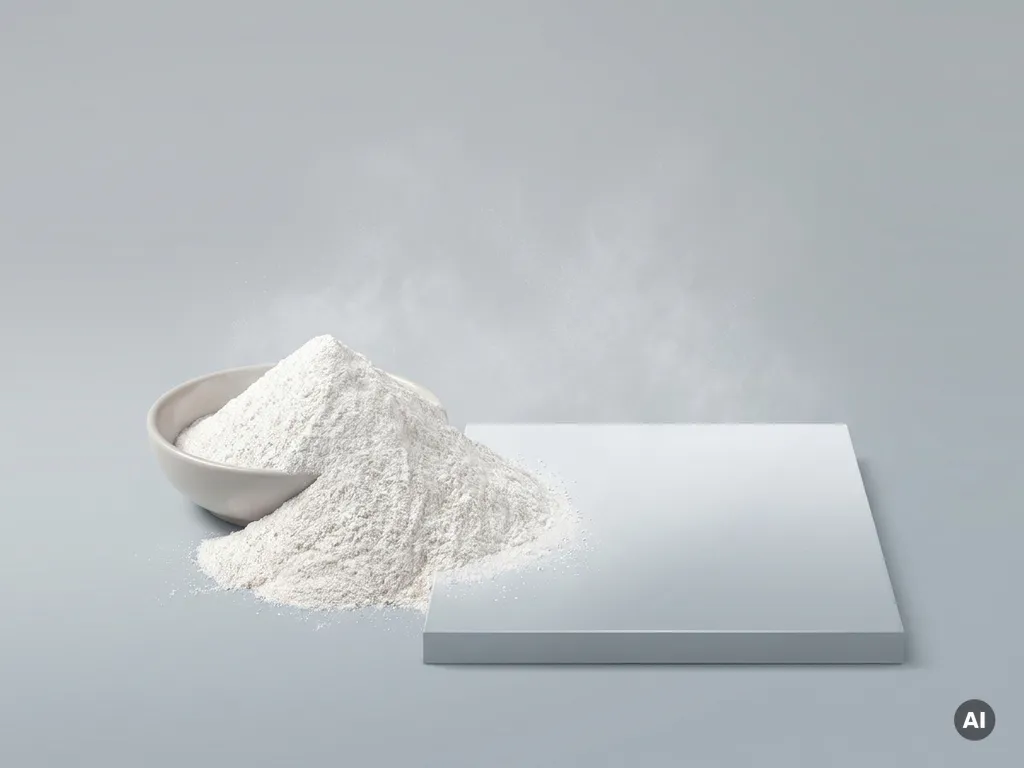
Barite improves the performance of paints and coatings by acting as a functional mineral filler that enhances chemical resistance, density, opacity, and surface smoothness while reducing cost per unit volume. As barium sulphate, it contributes properties that purely pigmentary or film-forming components cannot deliver alone. The sections below explore exactly how each of these performance benefits works in practice.
What properties make barite effective as a paint filler?
Barite is effective as a paint filler because of its high chemical inertness, high specific gravity, low oil absorption, and excellent particle size consistency. These properties allow formulators to incorporate it at meaningful loading levels without disrupting the stability of the paint system or degrading application performance.
Chemically, barium sulphate is one of the most stable mineral compounds used in industrial formulations. It does not react with acids, alkalis, or organic solvents, which means it remains passive within the binder matrix throughout the life of the coating. This inertness is not a passive quality: it actively protects the coating’s functional integrity over time.
Its high specific gravity, typically around 4.3 to 4.5 g/cm³, makes barite one of the denser mineral fillers available. This density contributes to the weight and barrier properties of the dried film. At the same time, its relatively low oil absorption means it does not consume excessive amounts of binder, which helps maintain cost efficiency and reduces the risk of brittleness at high loadings.
Particle size distribution is another key variable. Natural barite can be milled to a range of fineness grades, and finer grades contribute to smoother film surfaces, better gloss retention, and improved compatibility with other pigments and fillers in the formulation.
Looking for the right industrial minerals?
Our specialists help you find the right minerals and additives for your application.
How does barite affect the opacity and whiteness of coatings?
Barite does not provide opacity through light scattering in the way that titanium dioxide does. Its refractive index is relatively low, around 1.64, which means it is largely transparent in most binder systems. However, it contributes to whiteness as an extender by improving the distribution and efficiency of primary opacifying pigments such as TiO₂.
When used alongside titanium dioxide, barite acts as a spacer pigment. By physically separating TiO₂ particles within the coating matrix, it reduces pigment crowding and improves the optical efficiency of each TiO₂ particle. The result is that formulators can achieve comparable opacity with a lower total TiO₂ loading, which has significant cost implications given TiO₂’s price volatility.
In high-gloss and semi-gloss coatings, the fine particle grades of precipitated barium sulphate are particularly valued for their contribution to surface smoothness and brightness without introducing haze or reducing gloss. For paints and coatings applications where both whiteness and cost efficiency matter, barite’s role as a functional extender is well established.
Why is barite used in corrosion-resistant and industrial coatings?
Barite is used in corrosion-resistant and industrial coatings because its chemical inertness and impermeability to moisture and corrosive agents make it an effective barrier filler. When incorporated into protective coating systems, it contributes to the physical density of the film and reduces the rate at which corrosive species penetrate to the substrate.
Industrial environments expose coatings to acids, alkalis, salt spray, and a range of aggressive chemicals. Barite’s resistance to all of these makes it compatible with epoxy, polyurethane, and alkyd-based protective systems without risk of filler degradation or reaction. Unlike some mineral fillers that can introduce ionic species or absorb moisture, barium sulphate remains chemically passive under sustained exposure.
The filler’s density also contributes to the barrier effect. Denser, well-packed films are less permeable than lighter, more porous ones. By increasing the volume solids and film density of a protective coating, barite helps extend service life in demanding environments such as marine structures, industrial pipework, storage tanks, and heavy machinery. This makes it a practical choice for formulators targeting building and construction or industrial maintenance applications where long-term protection is the primary requirement.
How does barium sulphate influence coating rheology and application?
Barium sulphate influences coating rheology primarily through its particle size, shape, and surface area. In general, barite has a relatively low impact on viscosity compared to platy or fibrous fillers, which makes it easier to incorporate at higher loadings without significantly increasing the application viscosity of the formulation.
Its near-spherical particle morphology means it does not create the thixotropic or pseudoplastic effects associated with clays or talcs. This is advantageous in coatings where consistent flow and levelling are important, such as high-build industrial topcoats or automotive refinish products. Formulators who need to control sag resistance or film build without introducing excessive structure to the paint system often find barite a useful tool.
Surface-treated grades of precipitated barium sulphate (where the particle surface has been modified to improve compatibility with organic binders) offer even better dispersion and lower viscosity contribution. These grades are particularly relevant in high-gloss systems where agglomerates or poor dispersion would compromise surface appearance and film quality.
From a processing standpoint, barite’s hardness is moderate enough that it does not cause excessive wear on milling and mixing equipment, which is a practical consideration for production engineers managing high-volume coating manufacturing.
What is the difference between natural barite and precipitated barium sulphate in coatings?
The key difference between natural barite and precipitated barium sulphate in coatings is purity and particle control. Natural barite is mined and processed from mineral ore, while precipitated barium sulphate is synthetically produced through a chemical reaction, resulting in higher purity, tighter particle size distribution, and more consistent surface properties.
Natural barite
Natural barite, sourced from mining operations and then ground and classified, is the more cost-effective option and is widely used in industrial and decorative coatings where ultra-high purity is not a critical requirement. Its purity can vary depending on the ore source, and it may contain trace impurities that are acceptable in most industrial applications. It is available in a range of particle sizes and is well suited to primers, anti-corrosion coatings, and general-purpose industrial paints.
Precipitated barium sulphate
Precipitated barium sulphate is produced synthetically, which gives manufacturers precise control over particle size, morphology, and surface chemistry. The result is an extremely pure, fine, and consistent material with very low impurity levels. It is the preferred choice for high-gloss topcoats, automotive coatings, printing inks, and any application where surface quality, brightness, and formulation consistency are paramount. Its higher production cost is offset by its superior performance in demanding end uses. For sectors such as printing inks or precision industrial coatings, this level of quality control is often non-negotiable.
Which types of paints and coatings benefit most from barite?
The types of paints and coatings that benefit most from barite include anti-corrosion primers, industrial protective coatings, heavy-duty topcoats, and high-gloss decorative systems. Each of these applications draws on different aspects of barium sulphate’s performance profile.
- Anti-corrosion and protective coatings: Benefit from barite’s chemical resistance, barrier density, and compatibility with epoxy and polyurethane binders in demanding industrial environments.
- Marine and offshore coatings: Use barite for its resistance to salt spray and moisture penetration, contributing to long service life in harsh conditions.
- Automotive refinish and OEM coatings: Rely on precipitated barium sulphate for its contribution to gloss, surface smoothness, and TiO₂ efficiency in high-quality topcoats.
- Primers and fillers: Incorporate natural barite as a cost-effective extender that improves film build, sanding properties, and adhesion without compromising binder performance.
- Rubber and flooring coatings: Use barite’s density and wear resistance to add weight and durability to floor coatings and specialty rubber-based systems.
- Sealants and adhesives: Benefit from barite’s inertness and density as a functional filler, a context where SOD.DEL also supports formulators working in sealants and adhesives with consistent barium sulphate supply.
Across all of these applications, the choice between natural barite and precipitated barium sulphate (and the specific grade within each category) depends on the target performance specification, the binder system, and the cost structure of the formulation. Working with a technically knowledgeable mineral filler distributor helps formulators make the right selection for each application. SOD.DEL supplies barium sulphate to industrial producers across Western Europe and supports procurement and R&D teams in identifying the most suitable grade for their specific coating system. To discuss sourcing requirements, contact the SOD.DEL team directly.