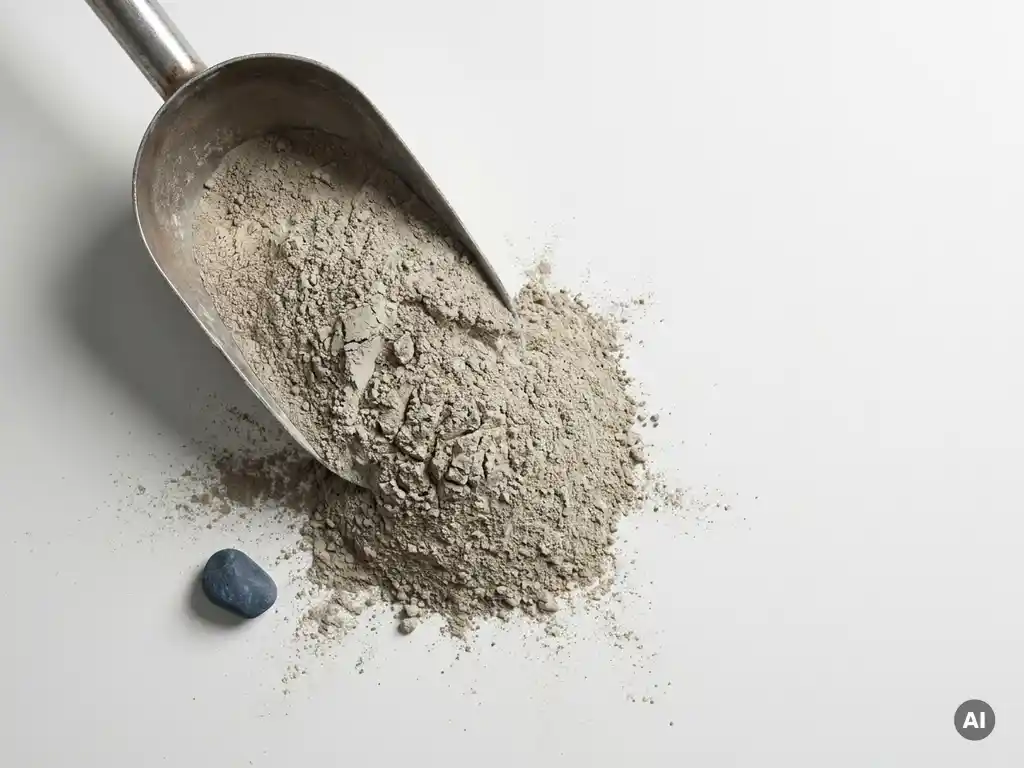
Bentonite is used in industrial manufacturing primarily as a rheology modifier, binder, and functional filler: it thickens, suspends, stabilizes, and reinforces across a remarkably wide range of production processes. Its unique swelling and gelling behavior in liquid systems makes it indispensable in applications where controlling viscosity, preventing sedimentation, or binding loose materials is critical. The sections below unpack the specific questions industrial buyers most commonly ask about this versatile clay mineral.
What makes bentonite different from other clay minerals?
Bentonite is a naturally occurring clay mineral composed predominantly of montmorillonite, a smectite-group mineral with an exceptional capacity to absorb water and swell to many times its dry volume. This swelling behavior, combined with its layered platelet structure, gives bentonite a unique combination of thickening power, colloidal stability, and ion-exchange capacity that most other clay minerals simply cannot match.
Where kaolin or talc function primarily as inert extender fillers, bentonite is an active functional mineral. Its platelets carry a net negative surface charge, which allows them to interact with water molecules and with other particles in a suspension. When dispersed in water, these platelets form a three-dimensional gel network that provides thixotropic behavior: the system thickens at rest and flows under shear. This property is the foundation of most of bentonite’s industrial uses. Organically modified grades extend this behavior into non-aqueous systems, broadening the mineral’s reach into solvent-based and polymer applications.
Looking for the right industrial minerals?
Our specialists help you find the right minerals and additives for your application.
What are the main types of bentonite used in industry?
The two primary industrial types of bentonite are sodium bentonite and calcium bentonite, distinguished by the dominant exchangeable cation in their interlayer structure. A third category, organoclay, is produced by chemically modifying sodium bentonite with quaternary ammonium compounds to make it compatible with organic solvents and polymer matrices.
Sodium bentonite
Sodium bentonite swells dramatically in water, forming high-viscosity gels at relatively low concentrations. It is the preferred grade for drilling muds, civil engineering applications, waterproofing membranes, and water-based paints and coatings. Its strong swelling capacity also makes it effective as a binder in foundry sands and iron ore pelletizing.
Calcium bentonite
Calcium bentonite swells less than its sodium counterpart but offers good adsorption properties. It is widely used in animal feed as a binding and anti-caking agent, in agriculture as a soil conditioner, and in certain clarification and purification processes. Calcium bentonite can be activated with soda ash to produce activated sodium bentonite, which approximates the performance of natural sodium grades.
Organoclay
Organoclay grades are surface-treated with organic compounds to render the naturally hydrophilic clay surface hydrophobic. This modification makes them compatible with oils, solvents, and polymer resins, unlocking bentonite’s rheological benefits in solvent-based coatings, greases, adhesives, and thermoplastic compounds where untreated bentonite would be incompatible.
How is bentonite used in paints and coatings?
In paints and coatings, bentonite functions as a rheology control agent that prevents pigment settling, improves sag resistance, and ensures a consistent application profile. Added at low concentrations, it builds a thixotropic gel structure in the liquid paint that keeps heavy pigments and fillers suspended during storage while allowing the paint to flow smoothly under brush, roller, or spray application.
The specific grade of bentonite selected depends on whether the coating is water-based or solvent-based. Sodium bentonite and its refined derivatives are used in aqueous architectural and industrial coatings, while organoclay grades are the standard choice for alkyd, epoxy, and polyurethane systems formulated with organic solvents. In both cases, the mineral contributes to film uniformity and reduces the risk of hard-cake settling, a quality concern that directly affects shelf life and end-user experience.
Beyond anti-settling, bentonite contributes to the overall texture and application feel of a coating. Formulators in the paints and coatings sector often use it in combination with other mineral fillers to fine-tune viscosity profiles across different shear rates, balancing open time, leveling, and sag resistance in a single formulation.
What role does bentonite play in plastics and rubber manufacturing?
In plastics and rubber, bentonite and its organoclay derivatives act as reinforcing fillers and rheology modifiers that improve mechanical performance, reduce permeability, and enhance processing behavior. Organoclay grades are particularly valued in nanocomposite applications, where the clay platelets can be exfoliated into individual nanometer-thick layers that disperse throughout a polymer matrix and dramatically improve barrier properties, stiffness, and thermal stability.
In plastics and polymer compounding, organoclays are incorporated into polyamide, polyolefin, and epoxy systems to create lightweight materials with improved gas and moisture barrier performance, relevant for packaging films, automotive parts, and engineering components. The platelet geometry of the clay creates a tortuous path for diffusing molecules, reducing permeability far more efficiently than conventional fillers at equivalent loading levels.
In rubber manufacturing, bentonite-based fillers contribute to compound stiffness and processing viscosity. They are used in both natural and synthetic rubber formulations, often alongside carbon black or silica, to adjust hardness, reduce cost, and improve dimensional stability in extruded and molded profiles.
Which other industrial sectors rely on bentonite?
Beyond coatings and polymers, bentonite is a critical raw material across a broad range of industrial sectors, each exploiting a different aspect of its functional profile.
- Sealants and adhesives: Bentonite and organoclay grades provide thixotropy and sag resistance in construction sealants and structural adhesives, preventing slump on vertical surfaces during cure. Formulators in sealants and adhesives rely on it to maintain bead geometry after application.
- Building and construction: Bentonite waterproofing membranes and geosynthetic clay liners are standard in civil engineering for landfill liners, tunnels, and basement waterproofing. The building and construction sector also uses it as a grout additive and in self-leveling floor compounds.
- Ceramics and refractory: As a plasticizer and binder in ceramic bodies and refractory mixes, bentonite improves green strength and workability. Its high-temperature behavior makes it suitable for ceramics and refractory applications where dimensional integrity during firing is essential.
- Agriculture and animal feed: In the agriculture and food sector, bentonite is approved as an anti-caking agent and mycotoxin binder in animal feed, and as a soil amendment to improve water retention in sandy soils.
- Detergents and chemistry: Bentonite’s ion-exchange capacity is exploited in fabric softeners and certain detergent formulations, where it conditions fibers and carries active ingredients. It also appears in chemistry and detergents applications as a carrier and thickener.
How do you select the right bentonite grade for a specific application?
Selecting the right bentonite grade requires matching the mineral’s key physical and chemical properties to the demands of the target application. The most important selection criteria are the carrier medium (water-based or solvent-based), the required degree of swelling or thickening, particle size distribution, surface treatment, and purity level relative to regulatory requirements.
For water-based systems, the choice typically falls between natural sodium bentonite, activated calcium bentonite, or refined grades with controlled particle size and low grit content. For solvent-based or polymer systems, an organoclay grade is necessary, and the specific organic modifier chemistry must be compatible with the solvent polarity and the polymer system’s processing temperature.
Purity and regulatory compliance add another layer of complexity. Applications in animal feed, pharmaceuticals, or food contact materials require grades that meet specific regulatory standards, with documented heavy metal limits and contaminant profiles. Industrial applications in coatings or construction are generally less restrictive, but consistency of supply and batch-to-batch reproducibility remain critical for production stability.
Working with a technically experienced distribution partner simplifies this selection process considerably. SOD.DEL’s team works directly with procurement and formulation professionals to identify the precise bentonite grade, particle size, and surface specification needed for each application, drawing on deep knowledge of both the mineral and the industries it serves. If you are evaluating bentonite options for your process, reach out to the SOD.DEL team to discuss your technical requirements.