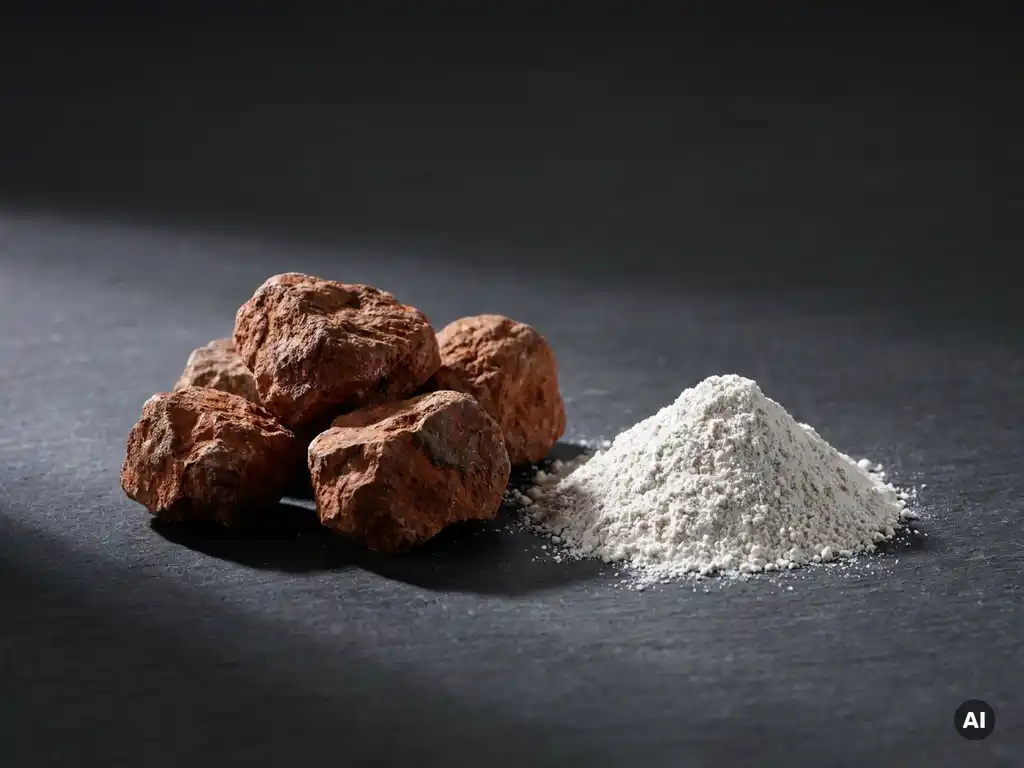
Bauxite and alumina are closely related but serve different roles in industrial use. Bauxite is a naturally occurring ore that contains aluminium compounds alongside iron oxides, silica, and other impurities. Alumina, chemically known as aluminium oxide (Al₂O₃), is the refined product extracted from bauxite through an industrial process. For most high-performance applications, alumina is the preferred choice, while bauxite retains value in specific sectors where its raw composition is an advantage.
Understanding which material fits a given application comes down to purity requirements, thermal performance, and cost constraints. The sections below address the most common technical questions formulators and procurement teams face when evaluating these two industrial minerals.
How is alumina produced from bauxite?
Alumina is produced from bauxite through the Bayer process, the dominant industrial method for refining aluminium oxide. Crushed bauxite is digested in a hot caustic soda solution, which dissolves the aluminium compounds while leaving iron oxides and silicates behind as a residue known as red mud. The aluminium-rich liquor is then cooled and seeded to precipitate aluminium hydroxide, which is subsequently calcined at high temperatures to yield alumina.
The calcination stage is particularly important for industrial applications. The temperature and duration of calcination directly influence the crystal structure and surface area of the resulting alumina, producing different grades suited to different end uses. Low-temperature calcination yields reactive alumina with high surface area, while high-temperature calcination produces dense, hard alpha alumina with superior thermal stability. This is why the term calcined alumina appears frequently in technical specifications for refractory, ceramic, and abrasive applications.
Looking for the right industrial minerals?
Our specialists help you find the right minerals and additives for your application.
What are the main industrial uses of bauxite?
Bauxite is used industrially in its raw or calcined form primarily in refractory materials, abrasives, cement, and the glass industry. Its value lies in its natural aluminium content combined with its availability and relatively low processing cost compared to refined alumina. Calcined bauxite, in particular, is prized for its hardness, high melting point, and resistance to wear.
Key industrial applications include:
- Refractory linings: Calcined bauxite is widely used in furnace linings, ladles, and kilns where high-temperature resistance is essential
- Abrasives: The hardness of calcined bauxite makes it suitable for grinding wheels, anti-slip surfaces, and road aggregates
- Cement and construction: Bauxite contributes to aluminate cements used in high-temperature and chemically resistant applications in building and construction
- Glass production: Bauxite serves as an alumina source in certain glass formulations where absolute purity is not the primary requirement
- Welding fluxes and electrodes: The mineral’s composition makes it useful in metallurgical applications
In most of these cases, bauxite is chosen because the presence of iron oxides and other natural compounds does not impair performance, and in some cases actively contributes to it.
What are the main industrial uses of alumina?
Alumina is one of the most versatile industrial minerals available, used across ceramics, refractories, abrasives, plastics, coatings, and electronics. Its high purity, chemical inertness, hardness, and thermal stability make it suitable for demanding technical applications where bauxite’s impurity profile would be disqualifying.
Common industrial uses of alumina include:
- Ceramics and refractories: High-purity alumina is a core material in advanced ceramics and refractory applications requiring extreme thermal performance
- Plastics and polymers: Aluminium trihydrate (ATH), a precursor to calcined alumina, is widely used as a flame retardant and filler in plastics and polymer compounds
- Paints and coatings: Fine alumina grades contribute hardness, abrasion resistance, and opacity in paint and coating formulations
- Abrasives: Alpha alumina is a primary component of grinding media, sandpaper, and polishing compounds
- Rubber: Alumina compounds serve as reinforcing fillers and processing aids in rubber manufacturing
- Sealants and adhesives: Aluminium-based compounds improve mechanical properties in adhesive systems
The range of available alumina grades, each with distinct particle size distributions, surface treatments, and purity levels, is what makes it such a widely specified material across industrial sectors.
Which is better for refractory applications: bauxite or alumina?
For refractory applications, the choice between bauxite and alumina depends on the operating temperature and the required purity of the finished product. Calcined bauxite performs well in moderate to high-temperature environments and is more cost-effective, making it a practical choice for general refractory linings. High-purity calcined alumina is the superior choice when operating temperatures exceed 1600°C or when chemical resistance and dimensional stability are critical.
Calcined bauxite typically contains 85–90% Al₂O₃ along with iron oxide and silica impurities. These impurities lower the melting point and can create weak phases at extreme temperatures, which limits performance in the most demanding thermal environments. High-purity alumina, by contrast, can reach an Al₂O₃ content above 99%, delivering exceptional refractoriness, low thermal conductivity variation, and resistance to slag and chemical attack.
In practice, many refractory producers use both materials: bauxite in cost-sensitive structural components and high-purity alumina in critical wear zones or areas exposed to the most intense heat and chemical contact. The right balance depends on the specific furnace design, operating cycle, and total cost of ownership over the lining’s service life.
What forms of alumina are available for industrial sourcing?
Alumina is available in several distinct forms for industrial sourcing, each suited to different applications based on its crystalline structure, particle size, and surface chemistry. The main forms are aluminium trihydrate (ATH), calcined alumina, tabular alumina, fused alumina, and reactive alumina.
- Aluminium trihydrate (ATH): The most widely used form globally, valued as a flame retardant filler in plastics, rubber, and cable compounds: it releases water when heated, suppressing combustion
- Calcined alumina: Produced by heating ATH above 1000°C; available in a range of calcination levels that determine hardness, surface area, and reactivity; used in ceramics, abrasives, and refractories
- Tabular alumina: Sintered at very high temperatures to produce dense, coarse-grained material with exceptional thermal shock resistance, used in premium refractory applications
- Fused alumina (white or brown): Produced by melting alumina in an electric arc furnace; extremely hard and pure, used in abrasives, grinding wheels, and high-performance refractories
- Reactive alumina: A fine-grained, high-surface-area calcined alumina used in technical ceramics and as a sintering aid
Selecting the right form requires a clear understanding of the target application’s thermal, mechanical, and chemical requirements. SOD.DEL’s technical team supports procurement and formulation professionals in identifying the precise alumina grade, including particle size distribution and surface treatment, that matches each specific production need.
When should a formulator choose bauxite over alumina?
A formulator should choose bauxite over alumina when cost efficiency is a priority, purity requirements are moderate, and the natural mineral composition of bauxite does not interfere with the end product’s performance. Bauxite is the right choice for applications where the iron oxide and silica content present in the ore are either tolerable or beneficial, and where paying the premium for refined alumina would not deliver a meaningful performance gain.
Practical situations where bauxite is the preferred raw material include:
- Refractory castables and bricks where mid-range alumina content (85–90%) is sufficient and cost control is a key specification driver
- Anti-slip road surfaces and flooring aggregates where hardness and wear resistance are the primary requirements
- Certain cement formulations where the iron content of bauxite contributes to the desired mineralogy
- Welding fluxes and electrode coatings where the full mineral composition is part of the functional recipe
Conversely, formulators working in high-purity ceramics, advanced electronics, precision abrasives, or flame-retardant polymer compounds will consistently require alumina, and specifically a grade matched to their process conditions. When the distinction between these two industrial minerals is unclear in a specific application context, working with a technically experienced distributor helps narrow down the optimal choice before sourcing decisions are finalized. For application-specific guidance, contact SOD.DEL’s team directly.