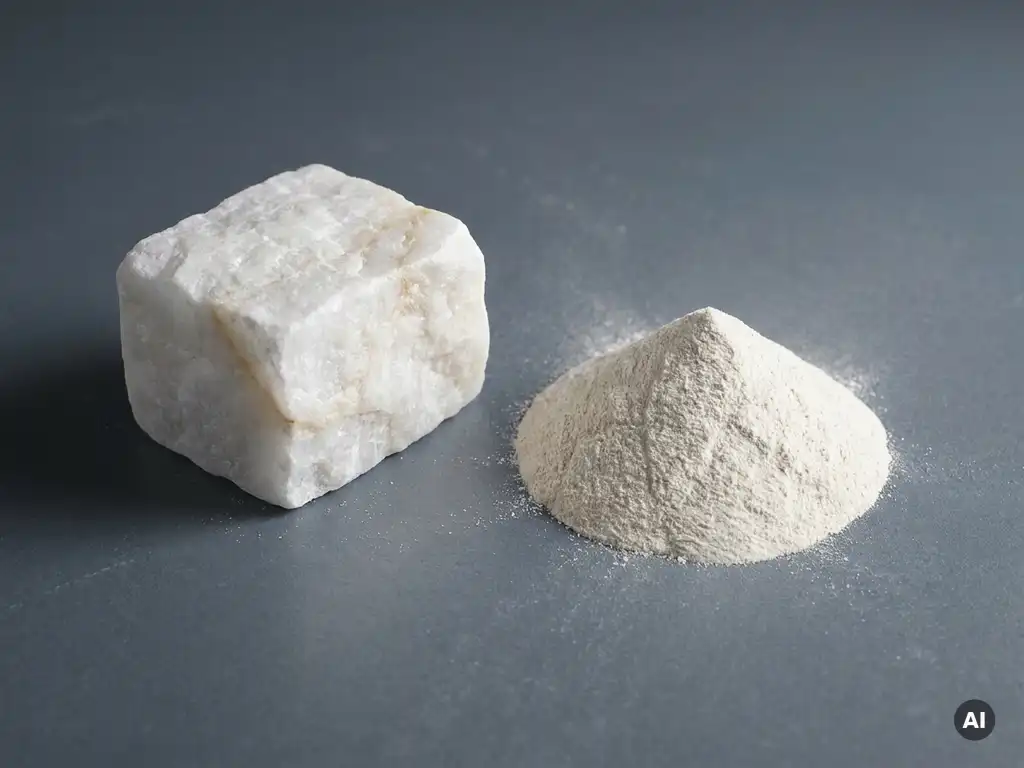
Natural calcium carbonate and precipitated calcium carbonate are both chemically identical (pure CaCO₃), but they differ fundamentally in how they are produced, their particle characteristics, and their performance in industrial applications. Natural calcium carbonate is mined and mechanically processed from rock, while precipitated calcium carbonate is synthetically manufactured through a controlled chemical reaction. That production difference drives almost every distinction in properties, cost, and suitability across industries.
For formulators, procurement managers, and production engineers, choosing between the two is rarely a matter of preference. It is a technical decision shaped by particle size requirements, surface chemistry, end-product performance, and budget. The sections below address the most common questions around NCC versus PCC, from basic production differences to practical switching decisions.
How is each type of calcium carbonate made?
Natural calcium carbonate (also called ground calcium carbonate, or GCC) is produced by quarrying limestone, marble, or chalk deposits and then mechanically crushing, grinding, and classifying the rock to the desired particle size. No chemical transformation occurs. The mineral is simply reduced in size and sorted. Precipitated calcium carbonate (PCC) is made synthetically: limestone is first calcined into quicklime (CaO), which is then slaked with water and reacted with CO₂ to re-form calcium carbonate under controlled conditions.
The key distinction is that PCC production gives manufacturers precise control over crystal structure, particle shape, and size distribution from the very start of the process. GCC production, by contrast, is constrained by the natural mineralogy of the source rock. This is why GCC grades vary depending on the quarry of origin, while PCC grades can be engineered to meet exact specifications regardless of the raw material source.
Looking for the right industrial minerals?
Our specialists help you find the right minerals and additives for your application.
What are the key physical differences between NCC and PCC?
The most significant physical differences between natural and precipitated calcium carbonate are particle size, particle shape, and surface area. GCC particles are typically irregular and angular, with a relatively broad particle size distribution. PCC particles can be manufactured in specific crystal habits (scalenohedral, rhombohedral, or aragonitic) and typically achieve much finer and more uniform particle sizes, often below 1 micron, with a higher specific surface area.
Purity is another differentiator. PCC is generally purer than GCC because the synthetic process eliminates most of the impurities present in natural limestone. GCC purity depends heavily on the quality of the source deposit. Brightness and whiteness also tend to be higher in PCC, which matters considerably in applications such as paper coatings, white paints, and food-grade uses where optical performance is critical.
Which industries use natural calcium carbonate versus precipitated?
GCC is the workhorse of high-volume industrial applications where cost efficiency and functional bulk are the primary drivers. PCC is favored in applications where fine particle size, controlled morphology, or high purity justify the additional cost.
GCC is widely used in building and construction materials, plastics and polymers, rubber, agriculture, and ceramics and refractory products, where large volumes are needed and particle precision is less critical. It also plays a major role in glass manufacturing as a source of calcium oxide.
PCC finds its natural home in applications demanding tighter control: paints and coatings where opacity and smoothness matter, sealants and adhesives where rheology must be precisely managed, printing inks where particle uniformity affects print quality, and pharmaceutical or cosmetic formulations where purity standards are non-negotiable. Detergent chemistry also makes use of PCC for its controlled reactivity and surface properties.
Does particle shape affect performance in formulations?
Yes, particle shape has a direct and measurable effect on formulation performance. In PCC, the ability to select specific crystal habits (such as scalenohedral (needle-like) or rhombohedral (blocky)) allows formulators to engineer rheological behavior, opacity, and mechanical reinforcement. Scalenohedral PCC, for example, creates a network structure in sealants and adhesives that improves sag resistance and thixotropy. Rhombohedral PCC packs more efficiently, which can improve surface coverage in coatings.
GCC particles, being irregular and angular, tend to pack less predictably and contribute differently to viscosity and flow. This is not always a disadvantage: in flooring compounds, flooring screeds, and construction mortars, the irregular shape of GCC particles can actually improve mechanical interlocking and dimensional stability. The practical lesson is that neither shape is universally superior; the right choice depends entirely on what the formulation needs to achieve.
Is precipitated calcium carbonate always more expensive than natural?
PCC is almost always more expensive than GCC on a per-tonne basis, and this price premium is inherent to the production process. Manufacturing PCC requires calcination, slaking, carbonation, and precise process control, all of which add energy and capital costs that do not exist in simple quarrying and grinding. The finer the target particle size and the more controlled the crystal habit, the higher the cost.
However, the total cost comparison is more nuanced than a raw price-per-tonne figure. PCC’s higher surface area and finer particle size often mean that lower loading levels achieve the same or better functional result compared to GCC. In some formulations, using PCC at a lower dose can offset part of the price premium. Formulators and procurement teams should evaluate cost-in-use (the cost per unit of function delivered) rather than cost per tonne when comparing the two materials.
When should formulators switch from GCC to PCC, or vice versa?
The decision to switch from GCC to PCC, or the reverse, should be driven by a clear change in performance requirements, cost constraints, or supply conditions, not by habit or availability alone. Switching from GCC to PCC makes sense when a formulation requires a finer and more uniform particle size distribution, improved whiteness or brightness, better rheological control, or higher purity that GCC from a given source cannot reliably deliver.
Switching from PCC back to GCC is justified when cost reduction is a priority and the functional requirements of the application can be met by a coarser or less uniform material. This is common when reformulating construction products, agricultural carriers, or high-volume plastic compounds where the performance threshold is achievable with natural grades. It is also worth reconsidering GCC when supply security is a concern: GCC is produced at a larger number of global sites, which can offer greater sourcing flexibility.
Any switch between GCC and PCC requires careful validation. Even when two grades appear similar on a datasheet, differences in surface chemistry, moisture content, and particle size distribution can affect processing conditions and end-product properties in ways that only application testing will reveal. Working with a technically knowledgeable distribution partner (one that can provide both grades and support the evaluation process) significantly reduces the risk of a poorly managed transition. SOD.DEL’s technical team works directly with formulators to identify the right calcium carbonate grade for specific applications, whether that means sourcing a cost-effective GCC or matching the precise PCC crystal habit a formulation demands. To discuss your mineral filler requirements, get in touch with the SOD.DEL team.