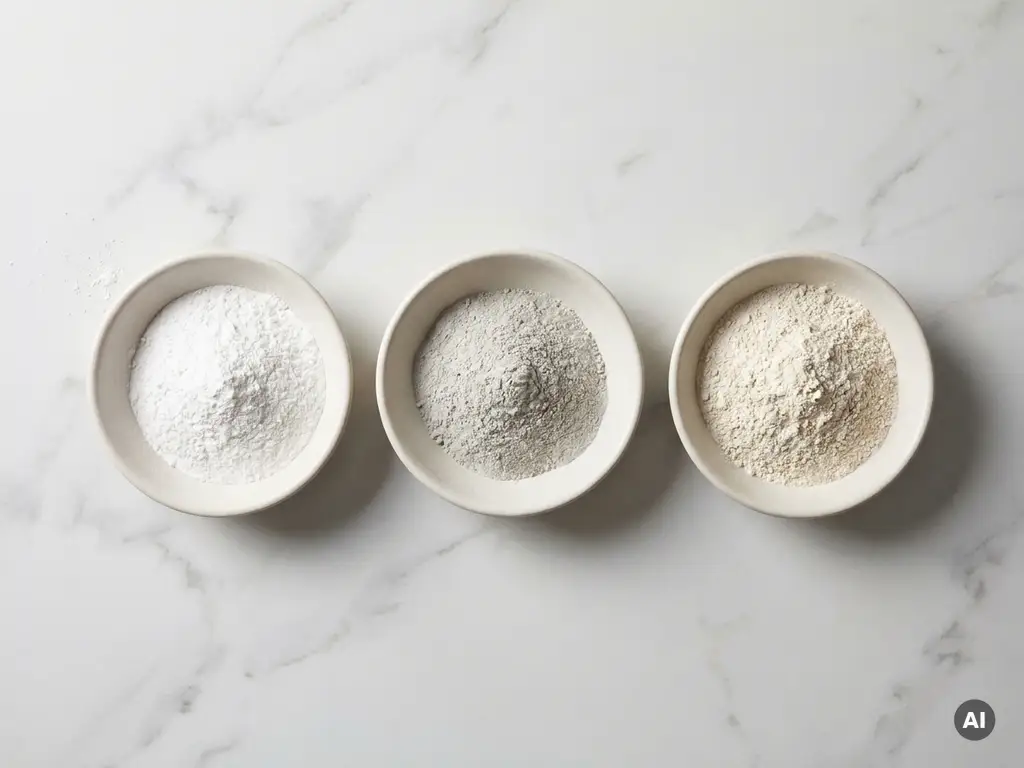
Mineral fillers improve product performance in industrial applications by modifying key physical, mechanical, and chemical properties of a formulation, including hardness, density, opacity, viscosity, and thermal stability. Rather than acting as passive bulking agents, functional fillers actively contribute to how a finished product behaves under real-world conditions. The sections below address the most common questions industrial formulators and procurement professionals ask when selecting and applying mineral fillers.
What properties of mineral fillers influence industrial performance?
The industrial performance of a mineral filler is determined by a combination of particle size and distribution, surface chemistry, aspect ratio, hardness, and chemical purity. These properties directly affect how a filler interacts with the surrounding matrix, whether polymer, resin, or binder, and how the final product performs under mechanical, thermal, or chemical stress.
Particle size distribution is often the most critical variable. Fine particles increase surface area and improve dispersion, while coarser grades may contribute more to bulk density and abrasion resistance. Surface treatment, such as coating a filler with fatty acids or coupling agents, determines how well it bonds with organic matrices, which in turn governs tensile strength, moisture resistance, and processing behavior.
Aspect ratio matters particularly in reinforcing applications. Platy minerals like mica or talc create barrier effects and dimensional stability, while fibrous or acicular particles improve stiffness. Chemical inertness and purity are equally important in sensitive applications such as pharma, food contact materials, or high-temperature ceramics, where trace contaminants can compromise both safety and performance.
.sd-cta-button{transition:background-color .2s ease;}
.sd-cta-button:hover{background-color:#183B70 !important;color:#ffffff !important;}
@media (max-width:600px){
.sd-cta{padding:20px !important;}
.sd-cta-button{width:100%;justify-content:center;box-sizing:border-box;}
}
Looking for the right industrial minerals?
Our specialists help you find the right minerals and additives for your application.
How do mineral fillers improve mechanical strength in plastics and composites?
Mineral fillers improve mechanical strength in plastics and composites by reinforcing the polymer matrix, increasing stiffness, and improving resistance to deformation under load. The degree of improvement depends on the filler type, its surface treatment, and how well it bonds with the host polymer.
In thermoplastics such as polypropylene or polyethylene, adding a well-dispersed mineral filler increases flexural modulus and reduces creep, the tendency of a material to deform slowly under constant stress. Calcined kaolin, for example, improves both stiffness and electrical insulation properties in cable compounds and engineering plastics. Barium sulphate, with its high density and chemical inertness, is widely used in polymer blends where sound damping and X-ray opacity are required.
Surface-treated fillers are particularly effective in composite systems. A coupling agent applied to the filler surface creates a chemical bridge between the inorganic mineral and the organic polymer, significantly improving interfacial adhesion. This translates into better impact resistance and tensile strength compared to untreated grades. For manufacturers active in plastics and polymer production, selecting the right mineral grade and surface chemistry is as important as the filler loading level itself.
What role do fillers play in paints, coatings, and sealants?
In paints, coatings, and sealants, mineral fillers serve multiple functional roles: they control rheology, improve hiding power, enhance durability, and reduce the cost of formulations without compromising film performance. They are not simply extenders; they are active contributors to the final coating’s mechanical and optical properties.
Calcium carbonate is one of the most widely used fillers in architectural and industrial coatings, contributing to smoothness, gloss control, and film build. Talc improves anti-corrosion performance and sag resistance in protective coatings, while precipitated calcium carbonate (PCC) offers tighter particle size control for high-gloss applications. Mica platelets create a lamellar barrier effect in anticorrosive primers, reducing moisture and ion permeability through the dried film.
In sealants and adhesives, fillers influence application viscosity, open time, and cured hardness. Calcium carbonate and bentonite are commonly used to adjust flow and prevent slumping in vertical joint sealants. For formulators working in paints and coatings or sealants and adhesives, the interaction between filler surface area, oil absorption, and binder demand is a central formulation challenge.
Can mineral fillers reduce formulation costs without hurting quality?
Yes, mineral fillers can meaningfully reduce formulation costs when selected and applied correctly, because they replace a portion of higher-cost components such as resins, pigments, or specialty polymers while maintaining or even improving specific performance attributes. The key is matching the filler’s functional contribution to the application’s technical requirements.
In coatings, replacing a share of titanium dioxide (TiO2) with a fine-particle calcium carbonate or a synthetic silicate can maintain opacity and whiteness at a lower raw material cost, provided the particle size and refractive index of the filler are optimized for the system. In plastics, increasing mineral filler loading reduces resin consumption per unit weight, but only if the filler is properly surface-treated to avoid brittleness or processing issues.
Cost reduction through fillers is not simply a matter of adding more cheap material. It requires a clear understanding of the performance thresholds the formulation must meet, and a systematic approach to substitution. Working with a technically experienced mineral distributor helps identify where cost-effective alternatives exist without introducing risk to product quality or regulatory compliance.
Which mineral fillers are used in building, ceramics, and refractory applications?
In building, ceramics, and refractory applications, the most commonly used mineral fillers include calcium carbonate, bauxite, alpha corundum, calcined kaolin, aluminium silicates, bentonite, and perlite, each selected for specific thermal, mechanical, or binding properties relevant to the application.
Building and construction
In building and construction, calcium carbonate and chalk are used extensively in renders, mortars, and dry-mix products for their contribution to workability and volume. Perlite, an expanded volcanic glass, serves as a lightweight filler in insulating plasters and ceiling tiles. Bentonite is used in waterproofing membranes and geotechnical applications due to its swelling behavior and low permeability.
Ceramics and refractory
In ceramics and refractory applications, thermal resistance and dimensional stability under extreme heat are the primary requirements. Alpha corundum (calcined aluminium oxide) is valued for its exceptional hardness and thermal stability, making it a preferred filler in refractory bricks and kiln furniture. Calcined kaolin reduces shrinkage during firing and improves the green strength of ceramic bodies. Bauxite, rich in aluminium oxide, is used in high-alumina refractories where resistance to slag and molten metal is essential.
How do you select the right mineral filler for a specific application?
Selecting the right mineral filler requires evaluating the application’s performance requirements against the filler’s key properties, particle size, surface treatment, chemical composition, and aspect ratio, and then validating the choice through formulation trials. There is no universal filler; the optimal choice depends on the specific matrix, processing conditions, and end-use demands.
Start by defining what the filler must achieve. Is the primary goal cost reduction, mechanical reinforcement, opacity, thermal resistance, or rheology control? Each objective points toward a different class of minerals. Once the functional requirement is clear, narrow the candidate list by processing compatibility: some fillers require surface treatment to disperse properly in non-polar matrices, while others are best used in aqueous systems.
Particle size distribution and oil absorption are two parameters that often determine whether a filler works in practice. High oil absorption can increase binder demand in coatings, leading to poor film formation. In plastics, an overly broad particle size distribution can create stress concentration points that reduce impact resistance.
For industrial manufacturers sourcing across multiple product lines and applications, working with a partner who holds deep application knowledge across a broad mineral portfolio significantly shortens the selection process. SOD.DEL’s technical team works directly with formulators to identify the right mineral grade, surface treatment, and supply format for each specific use case, whether the requirement is for a standard commodity grade or a tightly specified functional filler. If you have a formulation challenge or sourcing requirement, get in touch with the team to discuss the options.
Related Articles
- Hoe verbeteren minerale vulstoffen de productprestaties in industriële toepassingen?
- Hoe kies je de juiste minerale vulstof voor een specifieke toepassing?
- Comment les charges minérales améliorent-elles les performances des produits dans les applications industrielles ?
- What is calcium carbonate used for in industrial manufacturing?
- What is the difference between a mineral filler and a functional additive?