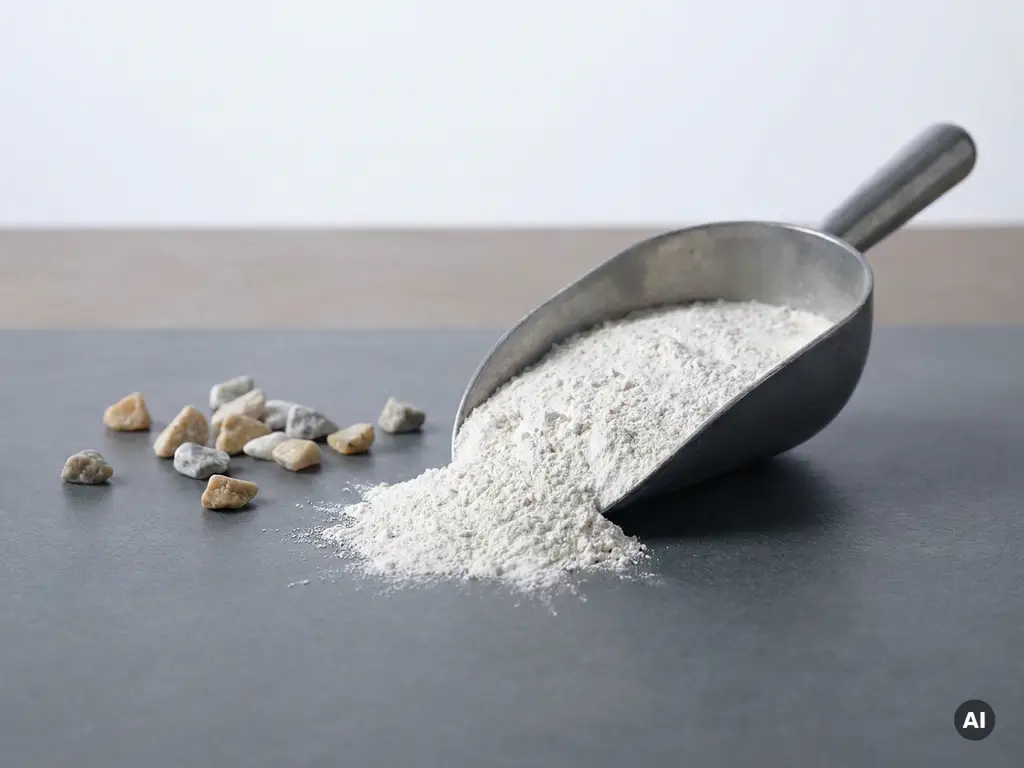
Calcium carbonate is one of the most widely used mineral fillers in industrial manufacturing, serving as a functional raw material across plastics, paints, adhesives, construction products, rubber, glass, and more. Its combination of chemical stability, fine particle availability, low cost, and compatibility with a broad range of binders and polymers makes it a default choice for formulators and production engineers alike. The sections below answer the most common technical and sourcing questions about industrial uses of calcium carbonate in detail.
What industries use calcium carbonate as a raw material?
Calcium carbonate is used as a raw material across a remarkably broad range of industries, including plastics and polymers, paints and coatings, sealants and adhesives, building and construction, rubber, glass, ceramics, paper, agriculture, and animal feed. Few mineral fillers match its combination of versatility, availability, and cost-effectiveness across such diverse manufacturing sectors.
In the plastics and polymers sector, CaCO3 functions as both a cost-reducing extender and a performance modifier. In building and construction, it appears in mortars, renders, dry-mix compounds, and flooring underlays. The glass industry uses calcium carbonate as a source of calcium oxide in the melt, while rubber manufacturers rely on it to control compound stiffness and reduce raw material cost.
Beyond these core sectors, calcium carbonate finds application in animal feed and agriculture as a calcium supplement and soil conditioner, in detergents as a carrier and abrasive agent, and in ceramics and refractory products where controlled calcium content influences sintering and microstructure. Its near-universal industrial relevance is why calcium carbonate consistently ranks among the highest-volume mineral raw materials traded in Europe.
.sd-cta-btn{transition:background-color .2s ease;}.sd-cta-btn:hover{background:#183B70 !important;color:#ffffff !important;}@media (max-width:600px){.sd-cta{padding:20px !important;}.sd-cta-btn{width:100%;justify-content:center;box-sizing:border-box;}}
Looking for the right industrial minerals?
Our specialists help you find the right minerals and additives for your application.
What does calcium carbonate do as a filler in plastics and polymers?
As a filler in plastics and polymers, calcium carbonate reduces raw material cost by partially replacing more expensive polymer resin, while simultaneously modifying mechanical properties such as stiffness, impact resistance, and surface finish. The specific effect depends on particle size, surface treatment, and loading level, making grade selection critical to achieving the target performance profile.
Coarse ground calcium carbonate grades are typically used for cost reduction and basic stiffness improvement in commodity applications such as PVC pipes, profiles, and cable compounds. Finer grades, particularly surface-treated variants coated with stearic acid, improve dispersion within the polymer matrix and contribute to improved impact strength and smoother surface aesthetics.
In polypropylene compounds, calcium carbonate filler is used to increase rigidity and dimensional stability in injection-molded parts. In PVC flooring and film, it serves as a primary extender that controls flexibility and density. Formulators working with polyolefins often find that optimizing the particle size distribution of their CaCO3 source allows them to maintain mechanical performance while meaningfully reducing compound cost, which is why selecting the right calcium carbonate grade for a specific polymer system is a technical decision, not a commodity one.
How is calcium carbonate used in paints and coatings?
In paints and coatings, calcium carbonate is used primarily as an extender pigment that improves paint rheology, controls sheen level, enhances film build, and reduces the demand for more expensive titanium dioxide. It contributes to opacity and hiding power when used in combination with TiO2, and its whiteness makes it suitable for interior and exterior architectural coatings.
Ground calcium carbonate grades with controlled particle size are the most common choice in decorative paints, where they influence the balance between scrub resistance, surface texture, and coating thickness. Finer grades with narrow particle size distributions are preferred in industrial coatings and primers, where film smoothness and pigment dispersion are more demanding.
Calcium carbonate also plays a role in the formulation of paints and coatings designed for exterior exposure, where its chemical stability under alkaline conditions, particularly in lime-based or cement-containing systems, makes it a durable and cost-stable extender. Formulators in this space often evaluate calcium carbonate alongside other mineral extenders such as talc, mica, or barite, selecting based on the specific performance requirements of the coating system.
What is the difference between ground and precipitated calcium carbonate?
Ground calcium carbonate (GCC) is produced by mechanically crushing and milling natural limestone or marble to a target particle size. Precipitated calcium carbonate (PCC) is synthetically produced through a controlled chemical reaction, yielding particles with a defined crystal structure, higher purity, and finer, more uniform particle size distribution. The key difference is that PCC offers greater control over particle morphology, while GCC is more cost-effective at higher volumes.
Ground calcium carbonate (GCC)
GCC is the dominant form used across most high-volume industrial applications. Its particle size can be adjusted during milling, and it is available in a wide range from coarse grades (for rubber and construction) to ultra-fine grades (for coatings and plastics). It is typically less expensive than PCC and is produced in large quantities from widely available limestone deposits. Surface treatments such as stearic acid coating are commonly applied to GCC to improve polymer compatibility and processing behavior.
Precipitated calcium carbonate (PCC)
PCC is manufactured by calcining limestone to produce calcium oxide, then reacting it with carbon dioxide under controlled conditions. This process allows manufacturers to control crystal habit, producing scalenohedral, rhombohedral, or aragonite forms, which in turn influence optical properties, surface area, and rheological behavior in the end product. PCC is preferred in applications demanding high whiteness, very fine particle size, and low abrasion, such as paper coatings, high-end sealants, and pharmaceutical or cosmetic formulations. It commands a price premium over GCC, which is justified where the performance requirements cannot be met by milled grades.
How does calcium carbonate affect product performance in sealants and adhesives?
In sealants and adhesives, calcium carbonate functions as a reinforcing filler and rheology modifier that controls viscosity, improves paste consistency, and reduces raw material cost. The right grade of CaCO3 can improve the application properties of a sealant, extend its open time, and contribute to the mechanical strength of the cured product, while the wrong grade can disrupt dispersion, reduce adhesion, or create processing problems.
Surface-treated calcium carbonate, typically coated with fatty acids, is the preferred form in silicone, polyurethane, and MS polymer sealants. The surface treatment prevents moisture absorption during storage, improves filler-polymer interaction, and supports smooth extrusion from cartridges or bulk packaging. In sealants and adhesives, the particle size distribution of the calcium carbonate directly influences the final viscosity of the uncured compound and the elongation at break of the cured product.
Formulators typically balance fine and ultra-fine CaCO3 grades to achieve the desired combination of sag resistance, surface finish, and mechanical flexibility. Because the performance impact of calcium carbonate in sealant systems is highly grade-specific, technical guidance from a knowledgeable distributor can make a meaningful difference in formulation efficiency.
What should manufacturers consider when sourcing calcium carbonate?
When sourcing calcium carbonate for industrial manufacturing, the most important factors to evaluate are particle size distribution, surface treatment, whiteness and purity, moisture content, consistency of supply, and the technical support available from the supplier or distributor. Selecting a grade based on price alone, without matching the mineral specification to the application, frequently leads to performance problems that cost more to resolve than the initial saving.
Particle size is the single most influential variable in most applications. A grade suitable for rubber compounding will perform poorly in a high-gloss coating, and a fine PCC designed for sealants will be unnecessarily expensive in a concrete admixture. Manufacturers should request full particle size data, including D50, D97, and top cut values, rather than relying on trade names alone.
Supply reliability matters as much as product specification. Consistent whiteness, stable particle size from batch to batch, and reliable delivery lead times are essential for production lines that cannot absorb raw material variability. Working with a distributor that maintains local stock and can supply in bulk, bags, or big bags (FIBCs) based on production volume reduces supply chain risk and simplifies logistics management.
SOD.DEL works with industrial manufacturers across Western Europe to match the right calcium carbonate grade to each specific application, drawing on deep product knowledge and direct relationships with leading mineral producers. For manufacturers looking to optimize their CaCO3 sourcing, getting in touch with the SOD.DEL team is a practical starting point for both technical and commercial guidance.
Related Articles
- Waar wordt calciumcarbonaat voor gebruikt in de industriële productie?
- Comment choisir la bonne charge minérale pour une application spécifique ?
- How do you select the right mineral filler for a specific application?
- Wat zijn de voordelen van het bundelen van de inkoop van minerale grondstoffen?
- What are mineral fillers and what are they used for?