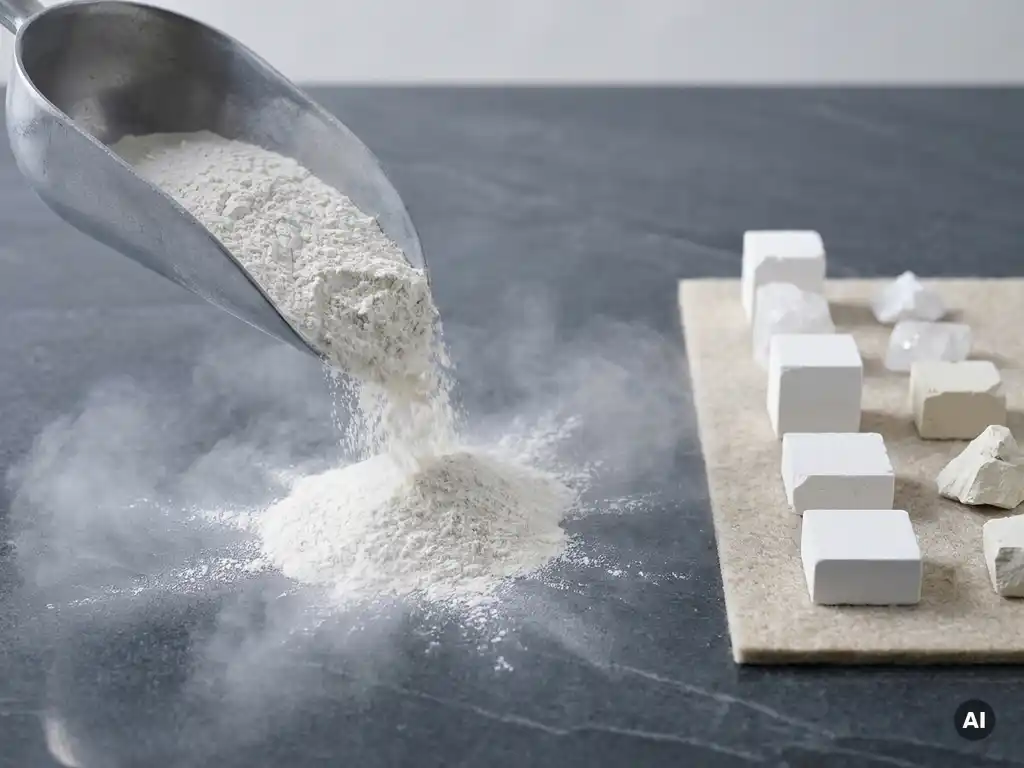
Mineral fillers are naturally occurring or processed inorganic minerals added to industrial products to modify their physical, mechanical, or chemical properties. They are used across a wide range of industries, from paints and plastics to construction and ceramics, to improve performance, reduce material costs, and achieve specific technical characteristics in the final product. The sections below answer the most common questions about mineral fillers, their applications, and how to select the right one for your process.
What types of minerals are commonly used as fillers?
The most commonly used mineral fillers in industrial applications include calcium carbonate, kaolin, talc, barium sulphate, mica, bentonite, bauxite, alumina, and silica. Each mineral offers a distinct combination of particle shape, hardness, chemical inertness, and surface area that makes it suitable for specific applications and formulations.
Calcium carbonate, available as ground calcium carbonate (GCC), chalk, marble, or precipitated calcium carbonate (PCC), is among the most widely used fillers globally, valued for its whiteness, availability, and cost efficiency. Kaolin and calcined kaolin are prized in coatings and ceramics for their plate-like particle structure and optical properties. Barium sulphate stands out for its high density and chemical resistance, making it a preferred choice in coatings requiring barrier performance. Mica delivers reinforcement and dimensional stability in plastics and rubber, while bentonite is favoured where swelling, thickening, or binding behaviour is needed. Alumina and bauxite serve high-temperature and refractory applications where hardness and thermal stability are critical.
The choice of mineral type is never arbitrary. Particle size distribution, surface treatment, purity, brightness, and morphology all determine whether a filler will perform as intended within a given formulation or process.
Looking for the right industrial minerals?
Our specialists help you find the right minerals and additives for your application.
What industries use mineral fillers in their products?
Mineral fillers are used across a broad range of industries, including paints and coatings, plastics and polymers, construction, rubber, ceramics, glass, sealants and adhesives, printing inks, agriculture, animal feed, detergents, and pharmaceuticals. Virtually any industry that manufactures a solid, semi-solid, or liquid product at scale is likely to rely on mineral fillers in some part of its formulation or production process.
In the paints and coatings sector, fillers such as calcium carbonate, talc, and barium sulphate control opacity, gloss, viscosity, and film build. The plastics and polymers industry uses fillers to improve stiffness, impact resistance, and dimensional stability while reducing the proportion of more expensive polymer resins. In building and construction, mineral fillers appear in mortars, renders, adhesives, and flooring compounds, contributing to workability, strength, and durability.
The rubber industry relies on fillers such as kaolin and silica to reinforce elastomers and extend service life. In ceramics and refractory manufacturing, minerals like alumina, bauxite, and silica aluminate provide thermal resistance and structural integrity at extreme temperatures. The agriculture and animal feed sector uses specific mineral grades as carriers, anti-caking agents, and soil conditioners. Even detergent and chemical manufacturers incorporate mineral fillers to adjust density, flow, and cleaning performance.
How do mineral fillers improve product performance?
Mineral fillers improve product performance by modifying mechanical, optical, thermal, and rheological properties of the host material. Depending on the mineral selected, they can increase hardness, improve dimensional stability, enhance barrier properties, control viscosity, reduce shrinkage, add whiteness or opacity, and improve fire resistance, all while often reducing the overall formulation cost.
In a paint formulation, for example, a well-chosen filler controls sheen and film thickness without compromising coverage. In a polymer compound, a plate-like filler such as mica reduces warpage and improves stiffness without significantly increasing weight. In a sealant or adhesive, fillers adjust flow behaviour and prevent sagging during application. In a refractory product, high-purity alumina or bauxite enables the material to withstand temperatures that would destroy organic or lower-grade mineral alternatives.
The performance benefit is always a function of the match between the mineral’s intrinsic properties and the demands of the application. Surface-treated fillers, for instance, offer improved compatibility with polymer matrices, reducing agglomeration and improving dispersion, which directly translates to better mechanical performance in the finished part.
What is the difference between a filler and an extender?
The difference between a filler and an extender lies primarily in function and intent. A filler is added to a formulation to modify specific technical properties, such as hardness, viscosity, or thermal resistance. An extender is added mainly to increase the volume of a formulation at lower cost, replacing a more expensive component without significantly changing the product’s core performance characteristics.
In practice, the distinction is not always sharp. Many minerals function as both fillers and extenders depending on the loading level and the application. In a high-quality architectural coating, calcium carbonate may serve as a functional filler contributing to film build and opacity. In a lower-cost formulation, the same mineral might be used primarily as an extender to replace a portion of the titanium dioxide (TiO₂), which is significantly more expensive. The intent and the concentration determine the role.
For industrial formulators, understanding this distinction matters because it shapes how a mineral is specified and evaluated. A filler selected purely for cost extension may underperform if the formulation also requires specific rheological or mechanical properties that the chosen mineral cannot deliver at the required loading.
How are mineral fillers supplied and delivered?
Mineral fillers are supplied in bulk, bags, or big bags (FIBCs), depending on the volume requirements and handling capabilities of the customer. Bulk delivery is common for high-volume industrial users with silo storage, while bags and big bags suit smaller quantities or production environments where precise batching is required.
Distributors such as SOD.DEL supply mineral fillers either directly from the producer’s quarry or manufacturing plant, or from regional stock held in their own warehouses. Maintaining local stock is critical for industrial customers who need reliable, short-lead-time replenishment, particularly in production environments where a raw material shortage can halt an entire manufacturing line.
For manufacturers operating across sealants, flooring, or other construction-related segments, the ability to consolidate multiple mineral grades through a single distribution partner simplifies procurement and reduces logistical complexity. Quality documentation, safety data sheets, and technical specifications typically accompany each delivery to support regulatory compliance and quality management requirements.
What should you consider when selecting a mineral filler?
When selecting a mineral filler, the key factors to evaluate are particle size distribution, mineral chemistry, surface treatment, purity, brightness, morphology, and compatibility with your existing formulation or process. No single mineral is universally optimal: the right choice depends on the specific performance requirements, processing conditions, and cost targets of your application.
Start with the end-product specification. If the application demands high whiteness and opacity, minerals with high brightness and low iron content, such as PCC or high-grade kaolin, are strong candidates. If thermal resistance is the priority, calcined or high-purity grades of alumina or bauxite become relevant. If the goal is reinforcement in a polymer, the aspect ratio and surface chemistry of the filler matter as much as its chemical composition.
Processing compatibility is equally important. A filler that performs well in a lab trial may cause dispersion problems at production scale if its surface treatment is not matched to the binder system or processing equipment. Regulatory requirements, particularly in food contact, pharmaceutical, or agricultural applications, add another layer of specification that must be verified before a mineral grade is approved for use.
Working with a technically knowledgeable distribution partner can significantly reduce the time and cost of this selection process. If you are evaluating mineral options for a specific application, contact SOD.DEL to discuss your requirements with a specialist who can match the right mineral grade to your process.
Related Articles
- À quoi sert le carbonate de calcium dans la fabrication industrielle ?
- Hoe kies je de juiste minerale vulstof voor een specifieke toepassing?
- Comment les charges minérales améliorent-elles les performances des produits dans les applications industrielles ?
- How do mineral fillers improve product performance in industrial applications?
- Wat is het verschil tussen een minerale vulstof en een functioneel additief?