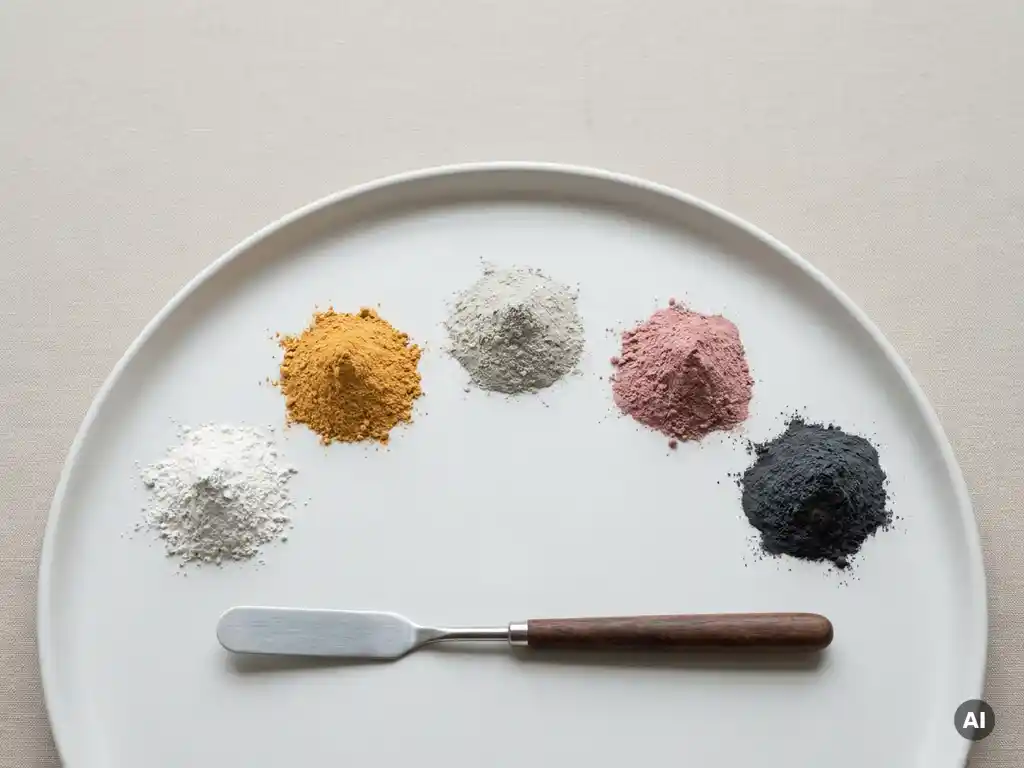
The main types of mineral fillers used in paints and coatings include calcium carbonate, kaolin, barium sulphate, mica, talc, and silica. Each filler brings a distinct combination of physical and chemical properties that directly influences how a coating behaves during application and over its service life. The sections below explore the most important fillers individually, covering their specific roles and the performance benefits they deliver.
How do mineral fillers affect paint performance?
Mineral fillers affect paint performance by modifying opacity, sheen, viscosity, mechanical strength, and durability without replacing the pigment or binder. They are functional raw materials that allow formulators to fine-tune a coating’s behaviour at every stage, from wet application through to long-term film integrity. Choosing the right filler, or the right combination of fillers, is one of the most consequential decisions in any coating formulation.
In practical terms, mineral fillers for paints and coatings serve several overlapping functions. They extend the volume of a formulation cost-effectively, reduce the demand for expensive titanium dioxide, control gloss levels, improve film build, and reinforce the dried coating against abrasion, cracking, and moisture ingress. The particle size, shape, surface treatment, and purity of each mineral all determine how it interacts with the binder system and how the final film performs on the substrate.
For industrial manufacturers sourcing fillers for paints at scale, the grade and consistency of supply matter as much as the mineral itself. Variation in particle size distribution or surface chemistry between batches can cause measurable shifts in viscosity, opacity, and application behaviour on the production line.
Looking for the right industrial minerals?
Our specialists help you find the right minerals and additives for your application.
What is calcium carbonate used for in paints and coatings?
Calcium carbonate is used in paints and coatings primarily as a volume extender and gloss modifier. It is one of the most widely used mineral fillers in coatings because it is chemically inert, white, and available in a broad range of particle sizes that allow formulators to control both texture and sheen. Ground calcium carbonate (GCC) and precipitated calcium carbonate (PCC) are the two main forms, each with distinct particle morphology and performance characteristics.
GCC, derived from natural chalk or marble, is cost-effective and widely used in interior and exterior architectural paints, where it contributes to film opacity and hiding power when combined with TiO2. Its relatively coarse particle size makes it useful for flat and matte finishes, where light scattering from larger particles reduces gloss. PCC, produced synthetically, offers finer, more controlled particle size distributions and is preferred in applications requiring smoother films or higher whiteness.
Beyond extension, calcium carbonate in paints contributes to rheological stability, helping to maintain consistent viscosity during storage and application. In water-based systems, it is compatible with most binder chemistries and does not introduce significant colour shift. For coating formulators working across paints and coatings applications, calcium carbonate remains one of the most versatile and cost-efficient minerals available.
Why is kaolin a common filler in coating formulations?
Kaolin is a common filler in coating formulations because its platy particle shape improves barrier properties, controls gloss, and enhances film smoothness. The flat, layered platelets align parallel to the coating surface during film formation, creating a more tortuous path for moisture and gases to penetrate. This makes kaolin as a paint filler particularly valuable in protective and industrial coatings where barrier performance is critical.
Calcined kaolin, produced by heating natural kaolin to remove hydroxyl groups, offers higher brightness and improved opacity compared to hydrous grades. It is frequently used as a partial TiO2 extender, helping formulators reduce reliance on expensive pigment without sacrificing hiding power. The calcination process also increases the mineral’s hardness and chemical resistance, broadening its usefulness in demanding coating environments.
In water-based architectural paints, kaolin contributes to a smooth, uniform finish and helps control sheen levels. Its natural whiteness and relatively low oil absorption make it compatible with a wide range of binder systems. For formulators working in industrial protective coatings or building and construction applications, kaolin’s combination of barrier enhancement and optical properties makes it a reliable and multifunctional choice.
What role does barium sulphate play in high-performance coatings?
Barium sulphate plays a critical role in high-performance coatings by providing exceptional chemical inertness, high density, and excellent gloss retention. Its extremely low reactivity means it does not interfere with binder chemistry, making it suitable for aggressive chemical environments. Barium sulphate in coatings is a preferred filler wherever resistance to acids, alkalis, solvents, and UV degradation is required alongside a high-quality surface appearance.
One of barium sulphate’s most valued characteristics is its refractive index, which sits close to that of many organic binders. This transparency in the binder matrix, combined with its very fine particle size in synthetic grades (precipitated barium sulphate, also known as blanc fixe), allows it to contribute to gloss and surface smoothness without the opacity associated with most white fillers. This makes it particularly useful in clear or translucent coating systems.
In automotive and industrial coatings, barium sulphate is used in primers and topcoats to improve surface texture, reduce sagging, and enhance the depth of gloss. Its high specific gravity also contributes to film weight and barrier thickness. For coating applications in demanding sectors such as rubber or plastics and polymers, where chemical resistance and surface quality are non-negotiable, barium sulphate delivers consistent and reliable performance.
How does mica improve durability in exterior coatings?
Mica improves durability in exterior coatings by reinforcing the dried film against cracking, UV degradation, and moisture penetration. Its large, flat platelets create a layered structure within the coating film that physically blocks the passage of water, oxygen, and UV radiation. As a mica filler for coatings, it is especially effective in exterior architectural and industrial protective coatings where long-term weathering resistance is a priority.
The platelet geometry of mica is central to its performance. When mica particles align parallel to the substrate surface, they extend the diffusion path for moisture and corrosive agents, slowing the rate at which these reach the substrate. This barrier effect directly reduces the risk of delamination, blistering, and corrosion in metal-protective systems and masonry coatings exposed to weathering.
Mica also contributes to dimensional stability in the coating film. Its high aspect ratio and rigidity resist the micro-cracking that occurs when coatings expand and contract with temperature cycles. In addition, mica’s natural reflectivity can reduce heat build-up in dark-coloured exterior coatings, further extending service life. For formulators developing products for flooring or exterior construction applications, mica is a well-established functional filler with a strong performance track record.
Which mineral filler is best for a specific coating application?
The best mineral filler for a specific coating application depends on the performance requirements of the finished film, the chemistry of the binder system, and the conditions the coating will face in service. There is no single universal answer, but matching filler properties to application demands is the foundation of effective formulation. The list below outlines the primary performance driver for each major filler type.
- Calcium carbonate: Best for volume extension, gloss reduction, and cost-efficient opacity in architectural paints and interior coatings.
- Kaolin: Best for barrier enhancement, gloss control, and partial TiO2 extension in industrial and architectural coatings.
- Barium sulphate: Best for chemical resistance, gloss retention, and surface quality in automotive, industrial, and high-specification coatings.
- Mica: Best for weathering resistance, crack resistance, and moisture barrier performance in exterior and protective coatings.
- Talc: Best for anti-settling, rheology control, and scratch resistance in primers and industrial coatings.
In practice, most coating formulations use a combination of two or more fillers to achieve the full range of required properties. A primer might combine talc for anti-settling and mica for barrier performance, while a topcoat might pair barium sulphate for gloss with calcium carbonate for cost efficiency. The optimal blend depends on particle size compatibility, oil absorption levels, and how each filler interacts with the specific binder and additive package in use.
Selecting the right industrial mineral fillers at the right grade and specification requires both formulation knowledge and reliable supply. SOD.DEL works directly with procurement and formulation teams to identify the precise mineral grade, particle size distribution, and surface treatment needed for each application. For manufacturers active in paints and coatings, consolidating mineral filler sourcing through a technically knowledgeable partner reduces both procurement complexity and formulation risk. To discuss specific application requirements, contact the SOD.DEL team directly.