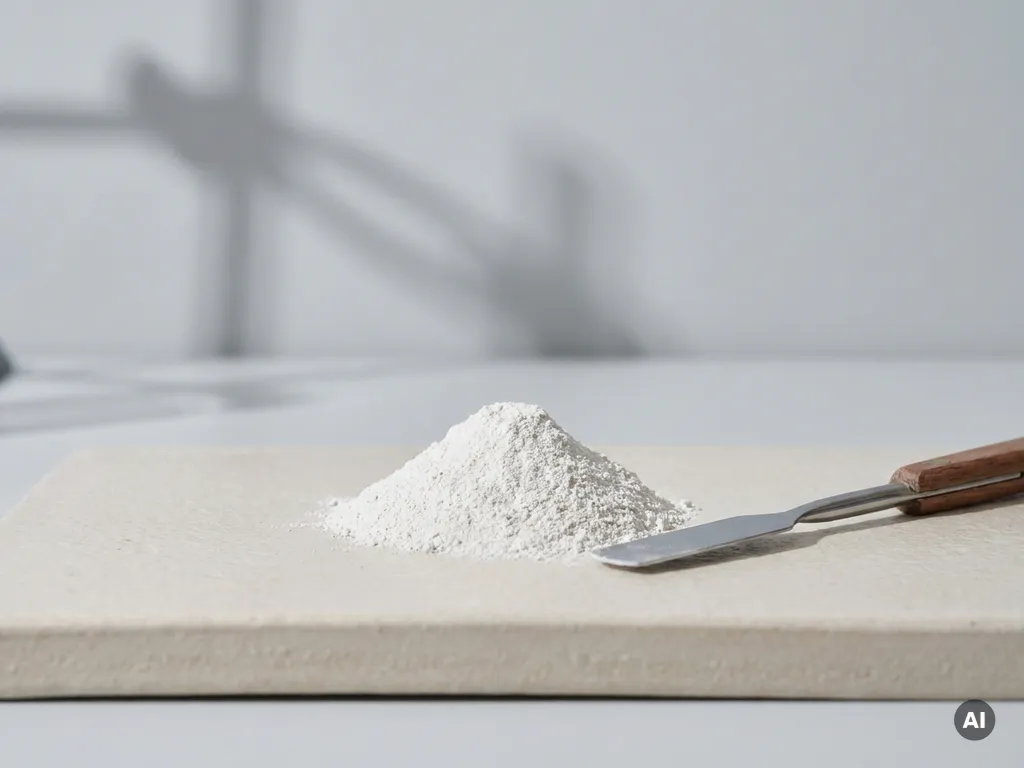
Calcined kaolin is a white, anhydrous aluminium silicate mineral produced by heating raw kaolin clay to temperatures between 600°C and 1000°C, a process that removes chemically bound water and transforms its crystalline structure. This thermal treatment gives calcined kaolin a distinct set of physical and chemical properties that make it significantly more useful than raw kaolin as an industrial filler. The sections below unpack the key questions procurement and formulation professionals ask when evaluating calcined kaolin for their applications.
How is calcined kaolin different from raw kaolin?
Calcined kaolin differs from raw kaolin in that it has been thermally processed to remove hydroxyl groups and water from its crystal lattice, fundamentally changing its surface chemistry, hardness, and optical behavior. Raw kaolin is a hydrated aluminium silicate with a layered structure and relatively low brightness; calcined kaolin is harder, brighter, more chemically inert, and less absorbent of water and organic binders.
The calcination process drives off structural water at temperatures typically ranging from 600°C to 1000°C. At lower temperatures, the result is a metakaolin phase with high reactivity, often used in cement and construction chemistry. At higher temperatures, the material converts to a harder, more stable form with improved whiteness and reduced surface reactivity. This means the grade of calcined kaolin you specify depends directly on the temperature at which it was processed, and different temperature ranges produce materials with meaningfully different behavior in formulations.
Where raw kaolin is relatively soft (around 2 on the Mohs scale) and hydrophilic, calcined kaolin sits closer to 3 to 4 on the Mohs scale and is significantly more hydrophobic in character. This shift matters in applications where moisture resistance, binder demand, or abrasion resistance are critical performance factors.
Looking for the right industrial minerals?
Our specialists help you find the right minerals and additives for your application.
What properties make calcined kaolin useful as a filler?
Calcined kaolin is valued as a filler primarily for its high brightness, low oil absorption, chemical inertness, and plate-like particle morphology. Together, these properties allow formulators to improve opacity, reduce binder consumption, enhance surface finish, and extend more expensive functional components in a formulation without sacrificing performance.
Key properties that drive its industrial utility include:
- High brightness and whiteness: Calcination removes organic impurities and iron-bearing compounds, producing a mineral with ISO brightness values that can exceed 90, making it effective as a functional white filler.
- Low oil absorption: Compared to amorphous silicas or some carbonates, calcined kaolin has relatively low binder demand, which supports higher filler loading without compromising rheology.
- Plate-like particle shape: The lamellar morphology of kaolin particles improves barrier properties in coatings and films by creating a tortuous path that resists moisture and gas transmission.
- Chemical inertness: Calcined kaolin is stable across a wide pH range and does not react with most organic systems, making it compatible with a broad range of polymer matrices and resin systems.
- Controlled hardness: Its moderate hardness provides mild reinforcement and can improve surface durability without causing excessive wear on processing equipment.
- Low thermal conductivity: This makes it useful in applications where thermal insulation is a functional requirement.
Which industries use calcined kaolin and for what purpose?
Calcined kaolin is used across a wide range of industries including paints and coatings, plastics and polymers, rubber, ceramics, sealants and adhesives, printing inks, flooring, and building and construction materials. In each case, it is selected for its combination of optical performance, reinforcing effect, chemical stability, and cost efficiency relative to other white mineral fillers.
Paints and coatings
In paints and coatings, calcined kaolin functions as an extender that partially replaces titanium dioxide while maintaining opacity and sheen. Its plate-like shape improves scrub resistance and reduces gloss in matte and satin formulations. It also enhances barrier performance in protective and anti-corrosion coatings.
Plastics, rubber, and polymers
In plastics and polymers and rubber, calcined kaolin improves stiffness, dimensional stability, and electrical resistance. Its relatively low moisture content and inert surface make it suitable for cable insulation compounds, where electrical properties and moisture resistance are critical.
Ceramics, refractory, and construction
In ceramics and refractory applications, calcined kaolin contributes to high-temperature stability and whiteness in ceramic bodies and glazes. In building and construction, including flooring and adhesive systems, it is used as a functional filler that improves mechanical properties and workability. Its pozzolanic reactivity at certain calcination temperatures also makes it relevant in cement and concrete formulations.
Printing inks and adhesives
In printing inks and sealants and adhesives, calcined kaolin contributes to rheology control, opacity, and surface smoothness. Its low oil absorption is particularly valued in ink formulations where binder efficiency directly affects cost and print quality.
How does calcined kaolin compare to other white mineral fillers?
Compared to other white mineral fillers such as calcium carbonate, talc, and barium sulphate, calcined kaolin stands out for its combination of brightness, plate-like morphology, and chemical inertness. The right choice between these fillers depends on the performance requirements of the specific application, but calcined kaolin occupies a distinct position where optical performance and barrier properties are both priorities.
Against calcium carbonate, calcined kaolin offers superior acid resistance, higher brightness in some grades, and better barrier performance due to its lamellar particle shape. Calcium carbonate is generally lower in cost and easier to disperse, making it the default extender where optical and barrier demands are moderate.
Against talc, calcined kaolin offers higher brightness and better electrical resistance, while talc provides superior lubricity and is often preferred in polypropylene compounding for its reinforcing effect and nucleating properties.
Against barium sulphate, calcined kaolin is lighter in density and typically lower in cost, though barium sulphate offers a higher refractive index and superior chemical resistance in highly aggressive environments.
In formulations where TiO2 extension is the goal, calcined kaolin is often the preferred extender because its particle size and refractive index can be matched to optimize light scattering alongside TiO2 particles, delivering meaningful cost reduction without proportional loss of opacity.
What particle size and grade should you specify for your application?
The correct particle size and grade of calcined kaolin depend on the application’s requirements for opacity, surface finish, dispersibility, and processing conditions. As a general rule, finer particle sizes improve surface smoothness and optical performance but increase oil absorption and can complicate dispersion, while coarser grades offer easier processing and are suited to applications where surface gloss is less critical.
For coatings where surface quality and TiO2 extension are priorities, grades with a median particle size (d50) in the range of 0.5 to 2 microns are typically specified. These fine grades offer the best optical contribution and the most effective barrier layer formation.
For plastics, rubber, and cable insulation compounds, coarser grades in the 2 to 10 micron range are common, offering a practical balance between reinforcement, electrical properties, and processability. In ceramics and refractory applications, coarser calcined kaolin grades are often preferred for their contribution to thermal stability and green strength.
Surface treatment is another specification variable. Some calcined kaolin grades are surface-treated with silane or stearic acid to improve compatibility with hydrophobic polymer matrices or to reduce moisture sensitivity. Specifying the correct surface chemistry is as important as specifying the right particle size, particularly in demanding polymer or rubber applications. Working with a technically knowledgeable distributor helps ensure that the grade selected matches the actual performance requirements rather than a generic product description.
What are the handling and formulation considerations for calcined kaolin?
Calcined kaolin is a fine, low-density powder that requires standard dust control measures during handling, including enclosed transfer systems and appropriate respiratory protection. In formulation, the main considerations are dispersion energy, oil absorption relative to the base system, and moisture sensitivity during storage.
Because calcined kaolin has a higher surface area than coarser mineral fillers, it requires adequate dispersion energy to break down agglomerates and achieve the particle size distribution specified on the technical data sheet. Insufficient dispersion leads to reduced optical performance, poor surface finish, and inconsistent rheology. High-shear mixing equipment is typically required for fine-grade calcined kaolin in liquid systems.
Storage conditions matter. Although calcined kaolin is significantly less hygroscopic than raw kaolin, it will still absorb atmospheric moisture over time, particularly in fine-grade forms. Bags and big bags should be stored in dry conditions and used promptly once opened to avoid changes in moisture content that can affect binder demand and dispersion behavior.
In formulations with reactive components, it is worth confirming that the calcined kaolin grade is free from residual reactive sites that could interfere with curing chemistry, particularly in epoxy or polyurethane systems. Most commercial calcined kaolin grades are sufficiently inert, but confirmation from the supplier’s technical documentation is good practice before scale-up.
For industrial manufacturers sourcing calcined kaolin across multiple applications or in significant volumes, working with a distributor that maintains reliable stock and offers application-matched grade selection simplifies procurement considerably. Contact SOD.DEL to discuss the right calcined kaolin grade for your specific formulation or production process.